
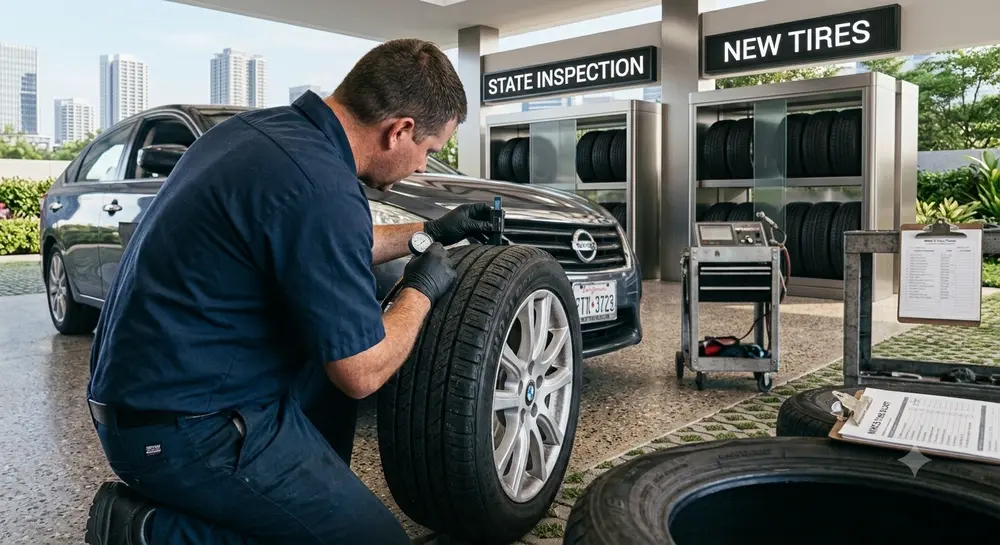
If you’re confused about whether you still need a Texas state inspection in Plano this year, you’re not alone — the rules changed in 2025, and a lot of drivers have been getting it wrong. The short version: the old annual safety inspection for most passenger vehicles is gone, but that does not mean inspections have disappeared entirely. Because Plano sits in Collin County, your vehicle very likely still needs an emissions test before you can renew your registration. Here at Mike’s Tires in Plano, we get this question every week, so we put together this plain-English guide to help you stay legal and avoid a rejected registration.
What Changed in 2025: House Bill 3297 Explained
For decades, nearly every Texas driver had to get an annual safety inspection — a technician checked your brakes, lights, tires, horn, wipers, and seat belts before you could register. That’s what most people pictured when they heard “state inspection.”
House Bill 3297 changed that. Effective in 2025, Texas eliminated the mandatory annual safety inspection for non-commercial passenger vehicles. If you drive a personal car, truck, SUV, or motorcycle for everyday use, you no longer have to pass a safety inspection just to keep your registration current.
It’s a real convenience — but it created a big misconception. Many drivers now assume all inspections are gone. That’s the part that trips people up, especially in the Dallas-Fort Worth area, where emissions rules still apply.
What HB 3297 did NOT eliminate
- Emissions inspections in designated emissions-program counties (including Collin County, where Plano is located).
- Safety inspections for commercial vehicles — those are still required.
- Initial inspections for new residents bringing a vehicle into Texas and for certain newly titled vehicles.
The New $7.50 Inspection Program Replacement Fee
Since the state no longer collects the old safety-inspection fee from most drivers, it replaced that revenue with a flat charge built into registration. When you renew, you’ll now see a $7.50 “inspection program replacement fee.”
A few things to know about this fee:
- It applies to non-commercial passenger vehicles that no longer need a safety inspection.
- You pay it at registration — no separate trip to a shop for the safety portion.
- It does not cover your emissions test if your vehicle is subject to one. Emissions testing is separate, and you still have to get it done.
Think of the $7.50 as the state swapping a service (the safety check) for a fee — it does not buy you out of the emissions requirement that still governs Collin County.
Who Still Needs a Texas State Inspection in Plano
This is the most important section for Plano drivers. Even with the safety inspection gone for personal vehicles, a large share of local drivers still have an inspection obligation.
1. Emissions testing in Collin County (this is most Plano drivers)
Plano is in Collin County, and Collin County is one of the Texas counties that requires vehicle emissions testing. The DFW emissions program covers a cluster of counties, including:
- Collin (includes Plano)
- Dallas
- Denton
- Tarrant
- Ellis
- Johnson
- Kaufman
- Parker
- Rockwall
If your registration address is in one of these counties, your vehicle generally needs to pass an emissions test to renew. This applies to most gasoline-powered vehicles that are roughly 2 to 24 years old. So a typical Plano commuter driving a car that’s a few years old absolutely still needs an emissions inspection — nothing about that changed with HB 3297.
2. Commercial vehicles
If you operate a commercial vehicle, the annual safety inspection is still required. HB 3297 only removed the safety-inspection mandate for non-commercial passenger vehicles. Fleet owners, contractors, and business owners running commercial-plated vehicles should plan on continuing safety inspections as usual.
3. New residents and newly titled vehicles
Just moved to Plano from out of state, or bringing in a vehicle that hasn’t been registered in Texas? You’ll typically need an initial inspection before you can register it here, and the same can apply when titling certain vehicles for the first time. Don’t assume the 2025 changes let you skip this step — handle it early so your registration goes through smoothly.
What an Emissions Test Actually Checks (OBD-II)
An emissions test isn’t the old head-to-toe safety check. It’s focused on one thing: making sure your vehicle isn’t putting excess pollution into the air. For most modern vehicles (1996 and newer), the test is done through the OBD-II port — the same onboard diagnostics system your mechanic plugs into.
During an OBD-II emissions inspection, the technician:
- Connects a scan tool to your vehicle’s OBD-II port.
- Checks that your emissions “readiness monitors” have run and reported ready.
- Confirms your Check Engine light is not commanding on — an illuminated light is one of the most common reasons vehicles fail.
- Reads for stored trouble codes related to the emissions system.
Older vehicles may go through a tailpipe-style test instead, depending on age and type. The big takeaway: if your Check Engine light is on, fix it before your test — a lit light will usually cause an automatic fail, no matter how well the car runs.
Which Vehicles Are Exempt
Not every vehicle in Plano needs an emissions test. Common exemptions include:
- Brand-new vehicles — the newest model-year vehicles are generally exempt for their first couple of years, since they aren’t yet in the 2–24-year testing window.
- Very old vehicles — vehicles older than the emissions testing window (roughly 25+ years) typically fall outside the requirement.
- Certain vehicle types — some motorcycles, and certain diesel, electric, or specialty vehicles may be handled differently or exempt depending on current program rules.
Rules and exact year windows can shift, so if you’re unsure whether your vehicle needs a test, confirm before your registration deadline. A quick check saves you a rejected renewal.
Cost, What to Bring, and How It Ties Into Registration
Cost
Costs come in two buckets. First, the $7.50 inspection program replacement fee that non-commercial drivers pay at registration — that number is set by the state. Second, if your vehicle needs an emissions test, there’s a separate emissions testing fee that varies by station and vehicle type; check with the testing location for their current rate.
What to bring
- Your vehicle (obviously) — and make sure it’s running well, with no Check Engine light on.
- Your current registration or renewal notice, if you have it.
- Proof of insurance, which is commonly required at inspection/registration steps.
- A form of payment for any applicable emissions testing fee.
How it ties into registration
In Collin County, your emissions test and registration are linked. When you pass emissions, the result is reported electronically to the state, so the system already knows your vehicle is compliant when you renew. If your emissions test is expired, failed, or never done, your registration renewal can be blocked until it’s resolved. The smart move: get tested a couple of weeks before your registration is due, not the day of.
How Mike’s Tires in Plano Helps You Stay Road-Ready
Now that the annual safety check is gone, no one is catching worn tires, bad brakes, or dead lights for most drivers — that responsibility falls on you. That’s a big deal on North Texas roads.
At Mike’s Tires in Plano, we’re your local shop for keeping your vehicle safe and reliable between registrations. Whether you need a fresh set of new tires for your commute or budget-friendly quality used tires, we’ve got you covered. And if you have questions about the current inspection and emissions rules, visit our Plano state inspection page for more local details.
Frequently Asked Questions
Do I still need a state inspection in Plano in 2026?
For a personal (non-commercial) vehicle, you no longer need the old annual safety inspection — you’ll pay a $7.50 inspection program replacement fee at registration instead. However, because Plano is in Collin County, you most likely still need an emissions test if your vehicle is roughly 2 to 24 years old. Commercial vehicles and certain new registrations still require inspection too.
What is the $7.50 fee I keep hearing about?
It’s the “inspection program replacement fee.” Since the state stopped requiring safety inspections for most passenger vehicles, it added this flat $7.50 charge to registration to replace the old inspection revenue. Important: it does not cover or replace your emissions test if your vehicle needs one.
Why did my car fail emissions?
The most common reason is an illuminated Check Engine light, which usually triggers an automatic fail. Other causes include emissions readiness monitors that haven’t completed, or stored trouble codes in the OBD-II system. If your Check Engine light is on, get it diagnosed and repaired before your test.
I just moved to Plano — what do I need to do?
New Texas residents typically need an initial inspection before registering a vehicle here, and Collin County vehicles are also subject to emissions testing. Handle this early so your first Texas registration goes through without delays.
Ready to keep your ride safe and road-legal? Now that the annual safety inspection is off the table for most drivers, staying on top of your tires and brakes is on you — and we make that easy. Stop by Mike’s Tires in Plano or contact our team today for honest advice, quality tires, and friendly local service you can trust.