
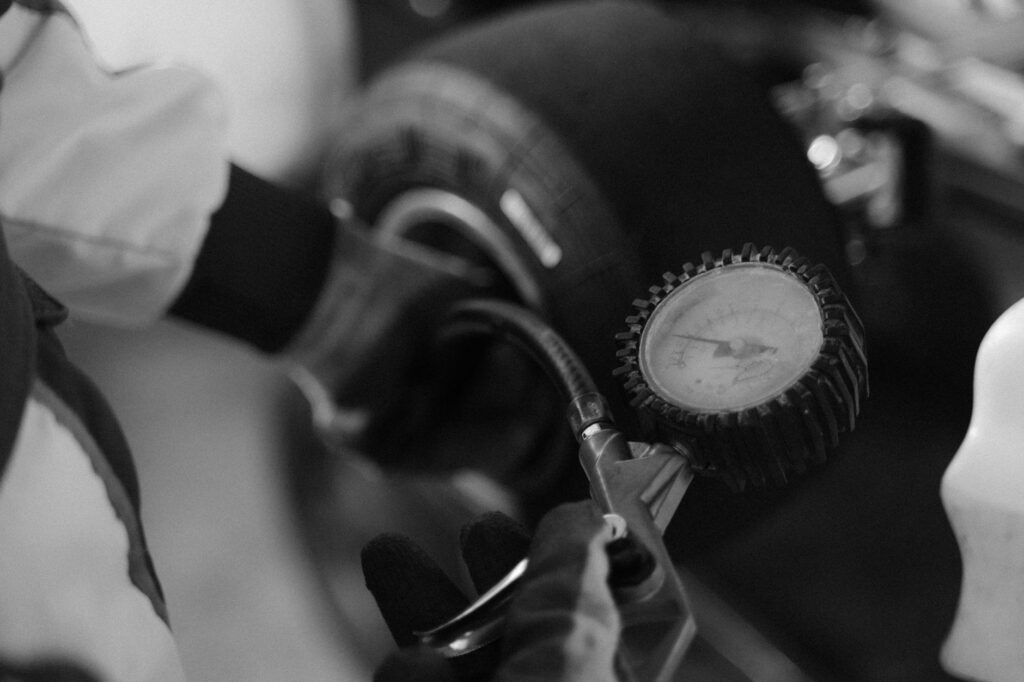
If you have ever stared at that little pressure symbol on your dashboard and wondered what to do next, learning how to check tire pressure is one of the simplest, highest-payoff skills a driver can pick up. It takes about five minutes, costs almost nothing, and it protects the four patches of rubber that keep your car connected to the road. Here in Plano and across North Texas, where summer pavement can hit blistering temperatures and winter cold snaps arrive fast, tire pressure swings more than most drivers realize. This guide from the team at Mike’s Tires Plano walks you through exactly how to do it right, what your numbers should be, and why it matters for your safety, your fuel bill, and how long your tires last.
What You Need to Check Tire Pressure
You only need one tool: a reliable tire pressure gauge. There are three common types, and any of them works as long as you use it consistently.
- Digital gauge: Easiest to read, accurate, and usually under $15. Great for most drivers.
- Stick (pencil) gauge: Cheap and durable with no batteries, though the sliding scale takes a moment to read.
- Dial gauge: Rugged and accurate, often preferred by enthusiasts.
Skip the built-in gauges on cheap gas-station air pumps when you can, since they are notoriously inaccurate. Keep your own gauge in the glove box. If you do not own one, stop by Mike’s Tires Plano and we will happily check all four tires for you and top off the air for free.
How to Check Tire Pressure Step by Step
Once you know how to check tire pressure the process becomes second nature. Follow these steps in order for an accurate reading every time.
1. Start with cold tires
Check pressure before you drive, or after the car has sat for at least three hours. Driving heats the air inside the tire and temporarily raises the PSI, which gives you a false high reading. First thing in the morning is ideal.
2. Remove the valve cap
Unscrew the small cap on the tire’s valve stem and set it somewhere you will not lose it, like a cupholder or your pocket.
3. Press the gauge onto the valve
Push the gauge straight onto the valve stem firmly and evenly. You will hear a short hiss as it seats, then it should go quiet. A continuous hiss means air is escaping around a bad seal, so reposition and press again.
4. Read the PSI
Look at the number. A digital gauge displays it instantly; a stick gauge pops out a measured bar. PSI stands for pounds per square inch, the unit tire pressure is measured in.
5. Compare to your recommended pressure
Match the reading against the manufacturer’s recommended PSI, then repeat for all four tires. Do not forget the spare, which loses air over time too. Replace each valve cap when you finish; it keeps dirt and moisture out of the valve.
Finding Your Correct PSI (Door Jamb, Not the Sidewall)
This is the single most misunderstood part of checking tire pressure. The big number stamped on the tire’s sidewall, often something like “51 PSI Max,” is the maximum pressure the tire can safely hold. It is not your target pressure.
Your correct PSI is set by the vehicle manufacturer and printed on a sticker inside the driver-side door jamb. Open the driver door and look at the frame where the latch meets the body. Most passenger cars and crossovers call for somewhere between 30 and 35 PSI. Trucks and some SUVs may run higher, and front and rear can differ. If the door sticker is missing or unreadable, the same figures live in your owner’s manual. Always inflate to the door-jamb number.
How Often Should You Check Tire Pressure?
The habit matters more than any single reading. Follow this simple schedule:
- At least once a month. Tires naturally lose about 1 PSI per month even when everything is perfect.
- Before every long road trip. Heading down I-75 to Houston or out to Austin? Check first, because highway heat plus a heavy load is exactly when a soft tire fails.
- Whenever the temperature swings sharply. More on that below, because North Texas is a prime example.
- Any time the dashboard warning light comes on.
What Low or High Tire Pressure Actually Does
Running the wrong pressure is not a minor issue. It changes how your car handles, how much you spend, and how safe you are.
Underinflated tires
- Wear out the edges. Low tires bow outward, so the outer shoulders scrub off while the center stays fine, shortening tread life dramatically.
- Waste fuel. Soft tires create more rolling resistance. Even 5 PSI low can cost you noticeable miles per gallon.
- Cause blowouts. An underinflated tire flexes and overheats, and heat is the number-one enemy of rubber. This is the classic summer-highway blowout.
Overinflated tires
- Wear out the center. Too much air balloons the tread so only the middle touches the road.
- Ride harsh and grip less. A rock-hard tire has a smaller contact patch, which reduces traction and makes braking less predictable, especially in the rain.
Correct pressure keeps the whole tread flat on the pavement, which is where you get even wear, the best grip, and the longest tire life.
How Texas Heat and Temperature Affect Tire Pressure
Here is the North Texas twist. Air pressure changes with temperature by roughly 1 PSI for every 10 degrees Fahrenheit. When it gets colder, pressure drops; when it gets hotter, pressure rises.
Plano weather makes this real. A tire you set to 34 PSI on a cool 45-degree December morning can climb well above the recommended level by a 95-degree July afternoon. And a tire that felt fine in the summer heat may trip the low-pressure warning on the first cold snap of fall. That is why so many dashboard warning lights pop up overnight after the season’s first cold front. It usually is not a leak, it is physics. Always set your pressure based on a cold reading and recheck after any big swing in the forecast.
Understanding the TPMS Warning Light
Most vehicles built since 2008 have a Tire Pressure Monitoring System (TPMS). When a tire drops roughly 25 percent below the recommended PSI, a horseshoe-shaped symbol with an exclamation point glows on your dash.
- Solid light: One or more tires are low. Check all four and inflate to the door-jamb spec.
- Blinking light, then solid: The TPMS sensor itself may have a fault or a dead battery. Have it inspected.
Never ignore the light. It is a genuine safety warning, and a tire that is 25 percent low is well into blowout territory. If yours will not go off after you have properly inflated the tires, swing by and we will read the sensors for you.
How to Add Air to Your Tires
If a tire is low, adding air is straightforward:
- Park within reach of an air compressor and remove the valve cap.
- Press the air hose nozzle onto the valve stem. You will hear air flowing in.
- Add air in short bursts, then check with your own gauge. It is easy to overshoot.
- If you go over, press the small pin in the center of the valve to release a little air, then recheck.
- Inflate all tires to the door-jamb PSI, replace the caps, and you are done.
Many gas stations charge for air and their gauges drift out of calibration. If you are near us, come use our free air and pressure check instead so you know the numbers are right.
Frequently Asked Questions
Should I check tire pressure when tires are hot or cold?
Always check cold, meaning before you drive or after the car has sat at least three hours. Driving warms the air and raises the reading by several PSI, so a hot check will fool you into underinflating.
What is the right tire pressure for my car?
Use the number on the sticker inside your driver-side door jamb, not the maximum printed on the tire sidewall. Most cars call for 30 to 35 PSI, but trucks and SUVs can differ, so always follow your vehicle’s spec.
Why does my tire pressure light come on when it gets cold?
Air contracts as temperatures fall, dropping about 1 PSI per 10-degree decrease. A Plano cold front can pull tires below the warning threshold overnight. Top them off to the recommended level and the light usually clears.
Can I drive on a tire that is a little low?
A short, slow trip to add air is fine, but do not drive far on a noticeably low tire. Low pressure builds heat and can lead to a blowout or ruin the tire. If it keeps losing air, you may have a leak that needs inspection.
Checking your tire pressure is a five-minute habit that saves you money, stretches your tread, and keeps your family safer on North Texas roads. If you would rather have a pro handle it, or your tires are due for a closer look, the crew at Mike’s Tires Plano is here to help. Stop in for a free air and pressure check, ask about new tires or quality used tires if your tread is getting low, get ready for your Texas state inspection, or contact us with any question. We are your trusted local tire shop in Plano, and we are always glad to help you roll safely.