
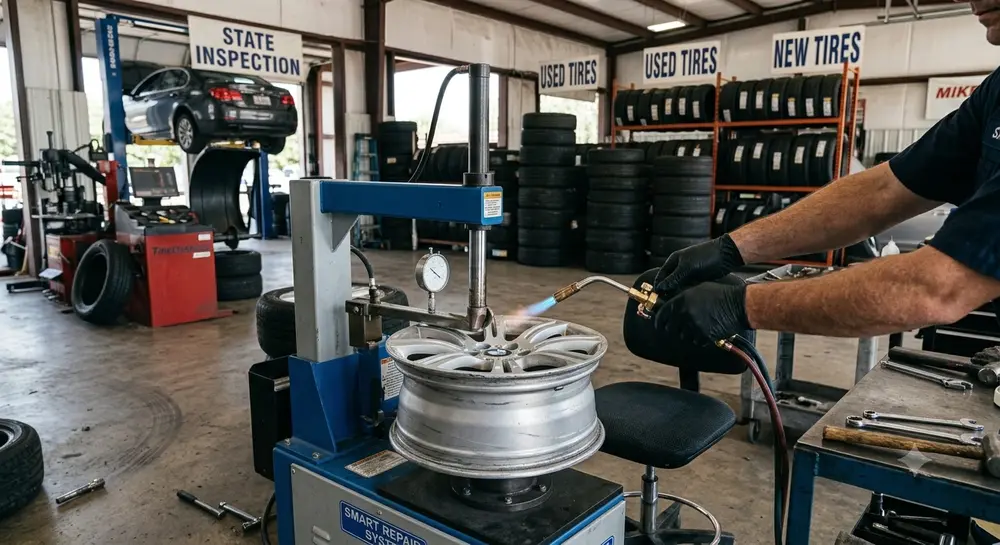
If your steering wheel shimmies at highway speed or a rim keeps losing air overnight, you are probably searching for honest answers about wheel repair in Plano before the problem gets worse. Wheels take a beating on North Texas roads, and the difference between a quick fix and an expensive replacement often comes down to catching the warning signs early. This guide walks you through what to watch for, how to tell a repairable wheel from one that needs to go, and when to bring your vehicle in to Mike’s Tires Plano.
Why Wheel Repair in Plano Is So Common
Plano and the wider North Texas area are tough on wheels. Sudden storms wash out road surfaces and leave fresh potholes almost overnight, and the region’s constant construction means lane shifts, uneven pavement seams, and curbs that seem to jump out at you. Add in cracking from our hot summers and the occasional icy snap, and it is easy to see why so many local drivers deal with bent rims. The good news: most wheel problems announce themselves well before they become dangerous, if you know what to listen and feel for.
Warning Sign #1: Vibration or Shaking While Driving
Vibration is the single most common symptom of a wheel problem, and it is easy to misread. Where you feel the shake tells a story.
- Steering-wheel shimmy at 45–65 mph: usually points to a front wheel that is out of balance or slightly bent.
- Vibration through the seat or floor: more often a rear wheel or tire issue.
- Shaking that worsens as you speed up: a classic sign of a bent rim or a lost wheel weight.
- Vibration only under braking: more likely a brake rotor issue than a wheel, but worth having checked.
Ignoring vibration wears your tires unevenly, stresses suspension and steering components, and turns a small balancing job into a bigger repair.
Warning Sign #2: A Bent or Cracked Rim
Hit a deep pothole or scrape a curb hard enough and the wheel itself can deform. This is where the most important decision in wheel repair lives, because a bent rim and a cracked rim are two very different situations.
How to spot rim damage
- A visible flat spot, lip that is pushed inward, or a wheel that no longer looks perfectly round as it spins.
- Repeated slow leaks that return even after the tire is reseated.
- A rhythmic vibration that a standard balance will not cure.
- Any hairline crack, split, or gouge in the metal, especially on the inner barrel or spokes.
Bent vs. cracked: safe to fix or not
- A bent rim is often repairable. Many steel and aluminum alloy wheels can be straightened and re-trued when the damage is limited to the lip or flange and the metal is not compromised.
- A cracked rim should be replaced, not repaired. Welding or filling a crack on a wheel that carries your vehicle’s weight at speed is a safety risk. Cracks tend to spread, and a failure at highway speed is exactly the scenario you want to avoid. When we find a crack, our honest answer is replacement.
If your current wheel is beyond saving, we can talk through fresh options, including matching your setup with quality new tires or budget-friendly used tires so the whole corner of your car works together again.
Warning Sign #3: A Persistent Slow Air Leak Around the Rim
If one tire keeps drifting down a few PSI every week but never shows a nail or puncture in the tread, the leak is often at the bead, where the tire seals against the rim. These “bead leaks” are frequently caused by corrosion or a small bend on the wheel’s sealing surface.
- Corrosion (white, chalky, or pitted metal on the rim edge) breaks the airtight seal.
- Road grime and old sealant buildup keep the tire from seating cleanly.
- A minor bend on the flange leaves a gap air can escape through.
Many bead leaks are fixable: the tire is dismounted, the sealing surface is cleaned and, if needed, lightly straightened, and the tire is remounted. Chasing a slow leak with the air pump instead of fixing the source just leaves you stranded on a bad morning.
Warning Sign #4: Visible Dents, Scrapes, or Corrosion
Sometimes the evidence is right there when you crouch down and look. Curb rash, gouges, and pitted, flaking metal are more than cosmetic.
- Curb scrapes that remove the clear coat expose bare metal to moisture and start corrosion.
- Dents on the rim lip can break the tire’s seal and throw off balance.
- Corrosion weakens the sealing surface and, over time, the structural integrity of an alloy wheel.
Light cosmetic damage can often be cleaned up and sealed. Deeper structural damage needs a professional eye to decide whether it is repairable.
Warning Sign #5: The Car Pulls or the Steering Wheel Sits Off-Center
If your vehicle drifts to one side on a straight, flat road, or the steering wheel sits cocked while you drive straight, something in the wheel-and-suspension system is off. A hard pothole or curb strike can knock a wheel out of alignment or bend a component. Pulling is not just annoying; it scrubs your tires down fast and unevenly.
Warning Sign #6: A Tire That Will Not Hold a Balance
This is a telltale sign. If you have your tires balanced, the vibration returns within days or weeks, and there is no obvious tire defect, the wheel itself is usually the culprit. A bent rim cannot be balanced away, no matter how many weights get added. When a balance will not “take,” it is a strong signal the wheel needs to be inspected for a bend or crack.
Warning Sign #7: A Thumping or Rhythmic Noise
A steady thump, thump, thump that speeds up as you accelerate often traces back to the wheel or tire. It can mean a flat spot on a bent rim, a tire with internal damage from a pothole hit, or a separated belt. Because the noise repeats with each rotation, it gets louder the faster you go. Do not wait this one out, especially before a road trip on I-75 or the Bush Turnpike.
Repair vs. Replace: Making the Right Call
Every wheel is different, but a few reliable rules guide the decision:
- Repair when the damage is a bent lip or flange, light curb rash, surface corrosion, or a bead leak, and the wheel’s core structure is sound.
- Replace when there is any crack, a severe bend, structural corrosion, or damage on the inner barrel. Safety wins over saving a few dollars, every time.
- When in doubt, get eyes on it. A quick professional inspection removes the guesswork.
Wheel Repair vs. Balancing vs. Alignment: Know the Difference
These three services get mixed up constantly, but they solve different problems.
- Wheel repair fixes the physical rim itself: straightening a bend, cleaning a corroded sealing surface, or replacing a damaged wheel.
- Wheel balancing uses small weights to even out the weight distribution of the tire-and-wheel assembly so it spins smoothly and does not vibrate.
- Wheel alignment adjusts your suspension angles so the tires meet the road correctly, keeping the car tracking straight and wearing tires evenly.
Often a pothole hit affects more than one of these at once, which is why a proper diagnosis matters. Fixing the rim but skipping the alignment leaves the job half done.
Frequently Asked Questions
Can a bent rim really be repaired, or do I need a new wheel?
Many bent rims can be safely straightened when the damage is limited to the lip or flange and the metal is not cracked. If we find a crack or severe structural damage, we will recommend replacement rather than a risky repair, because a wheel failure at speed is dangerous.
Why does my tire keep losing air with no nail in it?
A slow leak with no visible puncture is usually a bead leak, where the tire seals against the rim. Corrosion, road grime, or a slight bend on the sealing surface lets air escape. Cleaning and reconditioning that surface typically fixes it.
Is it safe to keep driving on a wheel with a slight vibration?
A mild vibration will not usually leave you stranded immediately, but it wears tires and suspension parts and tends to get worse. It is best to have it checked promptly so a small balance or repair does not turn into a larger bill.
Do I need an alignment after hitting a big pothole?
Often, yes. A hard impact can knock your alignment out, bend a wheel, or both. If the car pulls, the steering wheel is off-center, or you notice new vibration after a pothole, have the wheels and alignment inspected together.
Get Your Wheels Checked at Mike’s Tires Plano
Do not let a shimmy, a slow leak, or a mystery thump turn into a roadside emergency. The team at Mike’s Tires Plano will inspect your wheels honestly, tell you straight whether a repair is safe or a replacement is the smarter call, and get you rolling smoothly again. Ready to fix the problem or due for your Texas state inspection while you are here? Contact Mike’s Tires Plano today to schedule a visit.